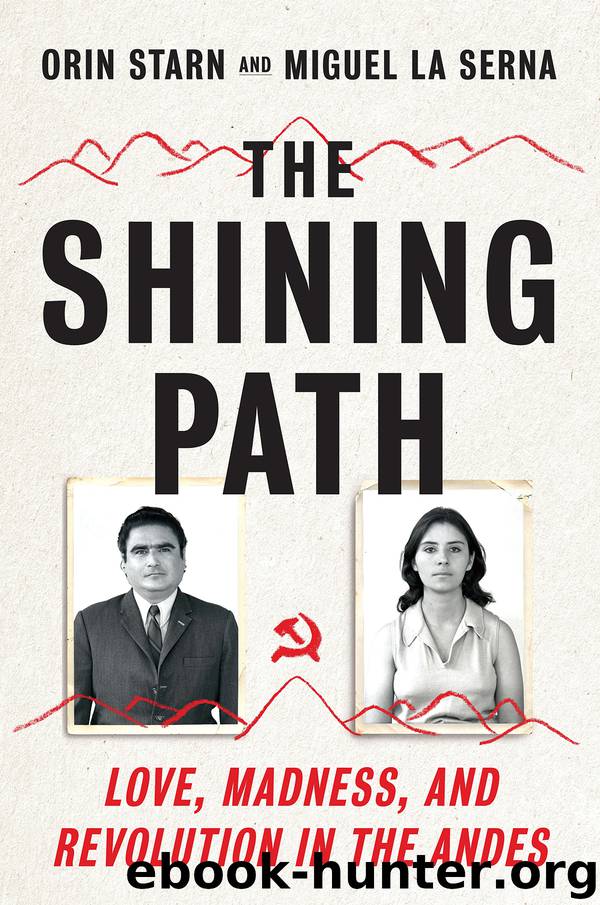
The Shining Path by Orin Starn
Author:Orin Starn
Language: eng
Format: epub
Publisher: W. W. Norton & Company
Published: 2019-02-19T16:00:00+00:00
CHAPTER FOURTEEN
A Fish Out of Water
Mario Vargas Llosa raised his hands to salute the crowd. More than thirty thousand people filled a Lima soccer stadium to cheer the novelist-turned-presidential candidate. Vargas Llosa had never imagined a political career. His boyhood dream was to be a matador, dazzling aficionados with his red cape and gleaming blade. The surrealist Michel Leiris once claimed that writing and bullfighting had risk in common. A blank page could be a capricious frightening beast, Vargas Llosa concurred. He enjoyed the new challenge of trying to master campaign crowds through his oratory. The country would pick a new president on April 8, 1990, less than four months away. He led the opinion polls.
Vargas Llosa was fifty-three, still boyish and handsome. His last venture into public service had been the 1983 Uchuraccay investigation. That ended with Vargas Llosa falsely blamed for covering up the army’s supposed killings of the journalists there. (“A useful idiot,” a leftist editorialist said.) Although the indignant Vargas Llosa insisted, unconvincingly, that the criticism did not bother him, he retreated to his study. He churned out two novels, Who Killed Salvador Palomino? and The Storyteller; a play; three short stories; and collected essays. His opinion pieces championed the free market and denounced state socialism’s brutality. (He continued to speak out against right-wing dictatorships, too.) Those views may have explained why the left-leaning Swedish Academy had not yet awarded Vargas Llosa the Nobel Prize. They had already denied the prize to another more center-right Latin American literary luminary. The great Jorge Luis Borges joked that he had lived so long that “the people in Stockholm thought they had already given me one.”
It had become Vargas Llosa’s new ambition to rescue Peru from itself. His native country always intrigued, maddened, and summoned him back. Now, the writer felt, it was reaching a point of no return. A discredited president and wrecked economy had led many Peruvians to lose faith in the system. If the senderistas won, they would yoke Peru into a troglodyte Communist dictatorship. Vargas Llosa regarded Latin America’s twentieth-century romance with populist strongmen, nationalist drumbeating, and Marxist revolution as the outdated worship of false gods. (He had recently depicted a bumbling, ideology-obsessed Trotskyite’s pathetic attempt at revolution in The Real Life of Alejandro Mayta.) That state socialism was falling to pieces, he felt, proved Western liberal democracy to be humanity’s best answer. Only a free, well-educated, market-oriented Peru would find its way forward.
That would take the right president, Vargas Llosa believed. He detested Alan García for his grandstanding, corrupt, and manipulative ways. Caballo loco, “Crazy Horse,” the president’s critics called him. Although Vargas Llosa regarded the senderistas as murderous fanatics, he was one of relatively few prominent Peruvians to denounce the 1986 prison butchery. That mountain of bodies, Vargas Llosa explained in an open letter to García, betrayed a true democracy’s obligation to human decency and the rule of law. The writer captained the opposition to García’s attempt to nationalize Peru’s banks a year later.
Download
This site does not store any files on its server. We only index and link to content provided by other sites. Please contact the content providers to delete copyright contents if any and email us, we'll remove relevant links or contents immediately.
| Arms Control | Diplomacy |
| Security | Trades & Tariffs |
| Treaties | African |
| Asian | Australian & Oceanian |
| Canadian | Caribbean & Latin American |
| European | Middle Eastern |
| Russian & Former Soviet Union |
The Secret History by Donna Tartt(18967)
The Social Justice Warrior Handbook by Lisa De Pasquale(12171)
Thirteen Reasons Why by Jay Asher(8856)
This Is How You Lose Her by Junot Diaz(6844)
Weapons of Math Destruction by Cathy O'Neil(6223)
Zero to One by Peter Thiel(5742)
Beartown by Fredrik Backman(5690)
The Myth of the Strong Leader by Archie Brown(5473)
The Fire Next Time by James Baldwin(5393)
How Democracies Die by Steven Levitsky & Daniel Ziblatt(5181)
Promise Me, Dad by Joe Biden(5120)
Stone's Rules by Roger Stone(5059)
A Higher Loyalty: Truth, Lies, and Leadership by James Comey(4919)
100 Deadly Skills by Clint Emerson(4888)
Rise and Kill First by Ronen Bergman(4744)
Secrecy World by Jake Bernstein(4709)
The David Icke Guide to the Global Conspiracy (and how to end it) by David Icke(4664)
The Farm by Tom Rob Smith(4475)
The Doomsday Machine by Daniel Ellsberg(4462)
